



Livestock Feed Production Equipment
10-15T/H Automatic Feed Pellet Production Line; Feed Pellet Processing Machines for sale
Description
Zhengzhou Fanda Machinery Co., Ltd. is one of the leading manufacturers and suppliers of livestock feed production equipment in China. With abundant experience, we warmly welcome you to buy cheap livestock feed production equipment for sale here from our factory. For price consultation, contact us.
10-15t/h Livestock Feed Production Equipment is designed to produce animal, livestock, and poultry feed for commercial use; it is a medium-size pellet line with a vertical structure.

Our engineering team designs the line based on client requirements and final feed specifications. Our engineering team specializes in feed pellet line design, including layout design, machine lists, installation drawings, and installation plans based on the client's building size. Our production team manufactures machines to high-quality standards and strong performance. Our installation team installs and commissions the machines and trains client staff.
We provide the main machines, conveying equipment, de-dust equipment, pneumatic elements, control system, and platform for a complete 10-15t/h Livestock Feed Production Equipment System. Our company designs, manufactures, and installs the entire system and provides long-term after-sales service. Based on your pellet requirements, our team can suggest raw material formulas and design a practical flow chart to process the raw materials into high-quality feed pellets.
A reasonable 10-15t/h Livestock Feed Production Equipment includes the following parts: Raw material receiving part, Grinding part, Raw material proportioning part, Mixing part, Pelletizing part, Pellet cooling and breaking part, Pellet sieving and packing part, Controlling system.
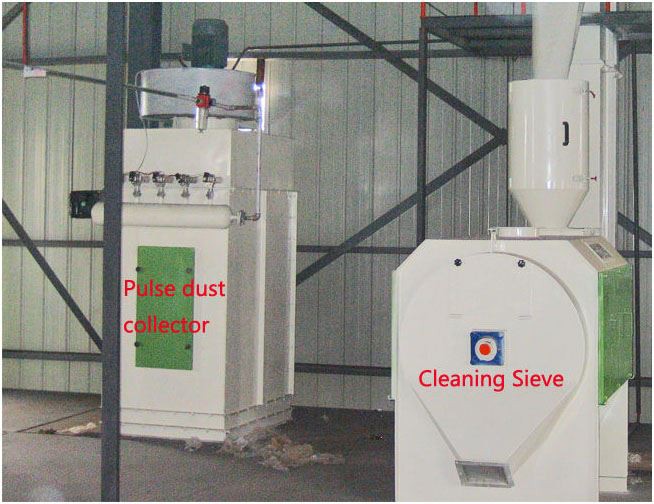
* The raw material receiving and cleaning part includes material receiving, pellet material cleaning, powdered material cleaning, dust collection, and conveying devices.
Raw materials go to the Livestock Feed Production Equipment from the inlet tank; granular material goes to a granular sieve, and powdered raw materials go to a powder sieve to remove stone, clay, iron, and other foreign material, thus making sure all the granular materials that go to the feed pellet production line are clean and without iron.
In this part, a pulse dust collector collects dust during cleaning to prevent pollution while the machines are operating.g
This system is equipped with a pneumatic tee and rotary distributor to control the material flow direction.
After cleaning, the granular material goes to the hammer mill via a bucket elevator, and the powdered material goes to the proportioning part director from the elevator. The electric control system controls all these machines; the engineering team designs the material flow direction and routes material to other destinations through pipes. Labor only needs to put raw material into the feeding inlet.
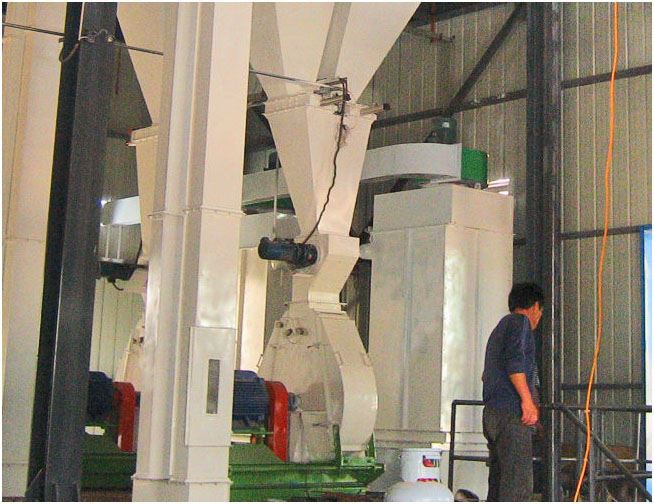
* The main equipment applied in the grinding part is the hammer mill; there is also an equipped conveying system, pneumatic control system, and pulse dust collector in the hammer mill.
Our hammer mill for the pellet production line is a water-drop-type hammer mill. This water-drop design improves material flow inside the hammer mill and increases grinding efficiency.
The motor connects to the hammer mill via a direct motor-rotor coupling, so the motor drives the rotor without a V-belt, improving transmission efficiency.
The grinding chamber opens from both sides, making it easier to maintain and replace hammers and screens. This design saves time and labor during maintenance.
The hammerhead is made of high-strength tungsten carbide, extending the hammer mill's service life.
The pulse dust collector on the hammer mill provides better de-dusting performance than the traditional cyclone de-dusting system.
After the granular material is ground in the hammer mill, the powder falls onto the screw conveyor connected under the hammer mill. It then goes to the bucket elevator and is transferred to the proportioning part.
An electric control system also controls this grinding system; therefore, it requires no manual labor.
* The material proportioning part is an important procedure for a feed pellet production line because it decides the ratio of each kind of raw material.
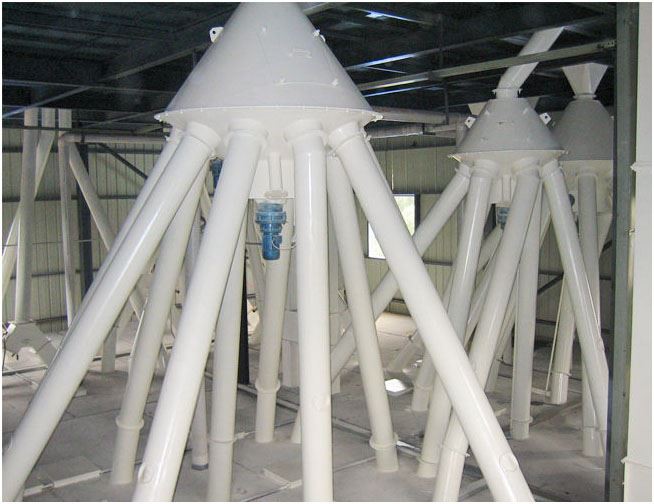
Feed pellet formulas for different animals, livestock, and poultry at different stages vary because they must meet their nutritional needs. So the proportion of each kind of raw material differs; each formula has a specific ratio of raw materials.
After these raw materials are ground into powders, each powder is stored in a hopper; the powdered raw material from the cleaning part is stored the same way. Under each hopper, a discharge auger releases the powder; an electric control system controls the auger and the weighing system. The batch weigher weighs each raw material according to the formula and controls the discharge auger to send powder to the buffer tank, then to the mixing machine.
Each hopper has a sensor to indicate the level of stored raw material.
A pneumatic system automatically controls the door under the buffer tank.
The proportioning system is equipped with a pulse dust collector to collect dust, thus keeping the working area clean.
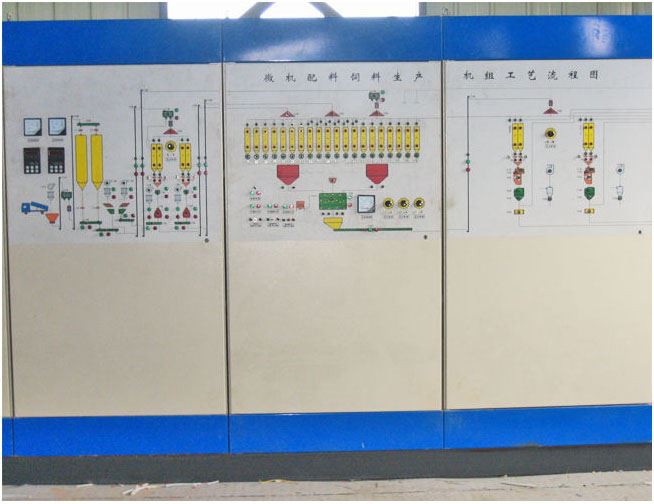
The proportioning part operates automatically under the central control system.
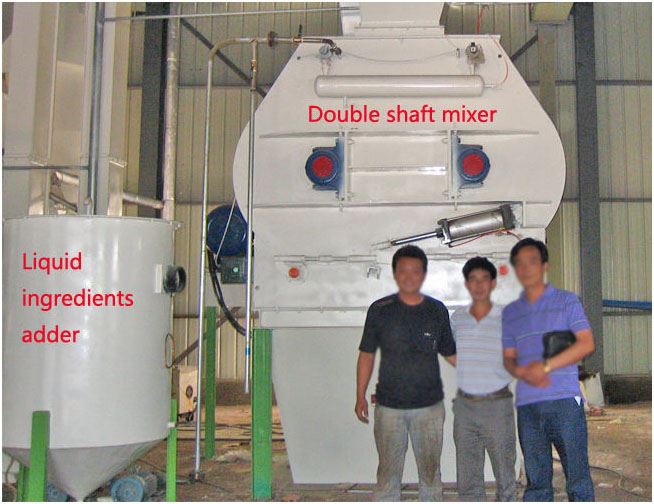 * The mixing part is designed to mix these powders evenly; we use a double-shaft mixer in this part.
A double-shaft mixer is widely used to mix powder, granular, flake, block, irregular, and sticky materials in the feed, cereal, food, chemical, pharmaceutical, pesticide, etc. industries.
Our SSHJ Series double-shaft high-efficiency mixer machine combines the best features of double-shaft paddle mixers at home and abroad. It is designed as low-speed, high-efficiency, energy-saving mixing equipment. It delivers high mixing homogeneity, no mixing dead angles, a short mixing period (30-120 seconds/batch), and even mixing. The entire bottom features pneumatic discharge with a large door opening, fast discharge performance, and low material residue; the discharge seal is reliable and leak-free. Loading offers a wide variable range and includes a grease-adding pipe in the machine body, which can add various liquids. The mixer has a compact structure and a sleek design, taking up less space than other mixing equipment. It mixes quickly and smoothly, with stable performance, low noise, and no dust or pollution.
The machine has two rotors rotating in opposite directions, with several special-angle paddles welded to each rotor. On one hand, the paddles drive materials along the machine's interior for anticlockwise rotation; on the other, they drive materials to turn around. The intersection overlap between the two rotors forms a weight-loss zone; in this area, regardless of material shape, size, and density, the material can float and become weightless at the moment. This causes the material in the machine tank to undergo continuous, all-wave turning, Intertwining, and cutting for fast, smooth mixing efficiency.
The rotor and its driving Rotor are composed of the paddle, shaft, and knighthead. The motor drives the rotor through a reducer and chain drive to a set operating speed; paddles installed on the double shafts at a specific angle can spill material throughout the container. Materials become instantly weightless and form an extensive cross-flow layer and mixing; the paddles also propel the material. Along the shaft, radial motion forms a combined wave cycle.
The machine body is W-type. Both ends of the machine body have a return duct. The machine body is connected by return duct, feeding, and discharging material; the air discharged by the material could circulate in this space and will not overflow outside the machine.
Discharging door and seal device: The Discharging door is composed of a door body, bracket arm, and adjusting nut. It seals the parts around the discharging door, and when the discharging door shuts tight, a rubber-sealed strip closes to seal the side parts of the door and prevent material leakage. Replace the sealed strip if it is damaged or aging. If necessary, adjust the adjusting nut to change the distance between the bracket arm and the door body, so the discharging door stays level with the machine shell bottom circular surface and seals properly.
The discharging control system is composed of a cylinder, connecting rod, universal driving shaft, and travel switch. The discharging door is installed on the universal driving shaft; the universal driving shaft connects to the assistant-driven rocker of the connecting rod, and the cylinder head hinges to the driven rocker. The cylinder reciprocates to rotate the universal driving shaft through the connecting rod, thereby opening or closing the discharging door.
A liquid-adding pipe is installed on top of the machine body; it consists of a pipe and nozzle, with the nozzle spraying the liquid sector. Several nozzles are distributed evenly on the machine shell. The inlet pipe has a flange and connects to the oil supply system.
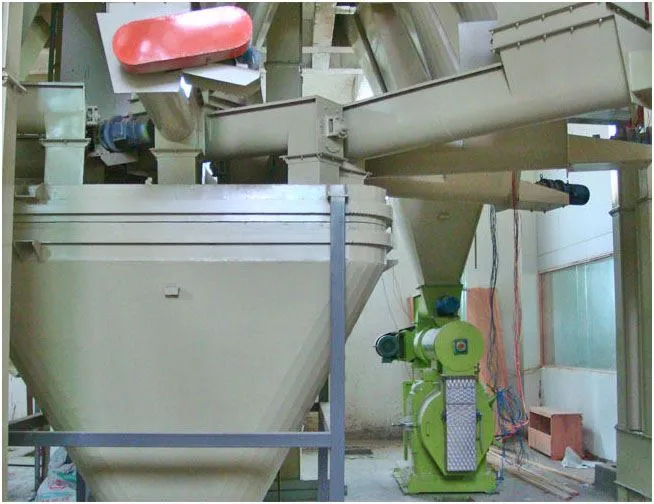 * The pelletizing part produces feed pellets from the mixed powder. We use a ring die pellet mill equipped with a stainless steel auger, stainless conditioner, and stainless steel ring die to produce high-quality feed pellets.
The ring die feed pellet machine produces high-quality feed pellets for animals, livestock, and poultry. Different animals require different materials; raw materials and ingredient formulas vary by feed pellet.
Our ring die feed pellet machine uses a horizontal ring-die design. The machine is equipped with a stainless steel conditioner, and the auger feeds raw materials into it. At the same time, the boiler supplies steam to the conditioner. The steam mixes with the raw materials inside the conditioner. The high-temperature steam sterilizes and cures the raw material, ensuring the final feed pellets are clean enough to meet food-grade standards and easy for animals to digest.
The ring die is the most important part of a ring die feed pellet machine for determining final pellet quality. The hole diameter determines the final pellet diameter, and the effective compression length determines the final pellet hardness. The hole diameter and effective compression length determine the ring die compression ratio, which in turn determines the quality of the pellets produced by the ring die pellet machine. Our engineer can calculate and design a suitable compression ratio based on the pellet diameter you want to produce and your raw material formula.
Horizontal ring die design, easy to feed, and simple to operate and maintain.
Equipped with a conditioner to sterilize and cure the raw material; the conditioner is made of stainless steel and meets the food-grade requirements.
The gearbox transmission system greatly improves transmission efficiency and increases production efficiency.
We use internationally renowned bearings for the main shaft and rollers to improve machine stability.
Our engineers can design different compression ratios and ring dies based on pellet diameter, final pellet use, and raw material formula to ensure high quality from our ring die pellet machine. ine
The parts that touch raw materials are all made of stainless steel
Equipped with a ring die lifter and an easy-to-change ring die
 * The cooling and pellet-breaking part is designed to cool the pellets. For some applications, a pellet breaker is needed to reduce the pellet size. Pellets discharged from the pellet mill are 70℃-90℃; if they are not cooled down, cracks will form on the pellet surface, so cooling pellets is an essential process in the feed pellet production line.
Our counterflow pellet cooler can cool pellets from 70℃-90℃ to room temperature in counterflow and reduce moisture content by < 10%, making the pellets easier to transport, store, pack, and keep. The counterflow cooler is a popular new type in the pellet market. It uses the counterflow cooling principle to cool high-temperature, high-moisture pellets. Counterflow pellets are fed into the airlock on top of the counterflow cooler and fall inside the cooling tank. Counterflow cold air comes into the cooling tank at the bottom of the pellet cooler. A counterflow air fan supplies the counterflow air, and inside the cooling tank, hot pellets meet the cold air. Counterflow air mixes with hot pellets; the pellet temperature drops, and the pellets are discharged through the discharge door to the discharge chute, while hot air and dust are drawn to the air fan. The air fan finally discharges hot air through the discharge pipe, and dust goes to the dust tank at the bottom of the cyclone.
On the pellet cooler, there is a sensor to indicate the level of pellets inside the cooling tank, inside the electric panel there is a time delay, the sensor and time relay work together to control the cooling time and discharge time, when pellet level inside the cooling tank reaches the upper level and cooling time reached, the time relay gives a signal to the electric panel, the panel control motor or air cylinder running to open the discharge door, pellets start to go to discharge chute from cooling tank until the level of the pellets inside the cooling tank reaches the lower level the sensor give panel signal to start the motor or air cylinder to close the discharge door and stop discharge pellets.
The whole process works automatically; the sensors, time relay, and electric panel control the process. If you want to control the cooling process manually, you can set the electric panel to manual control.
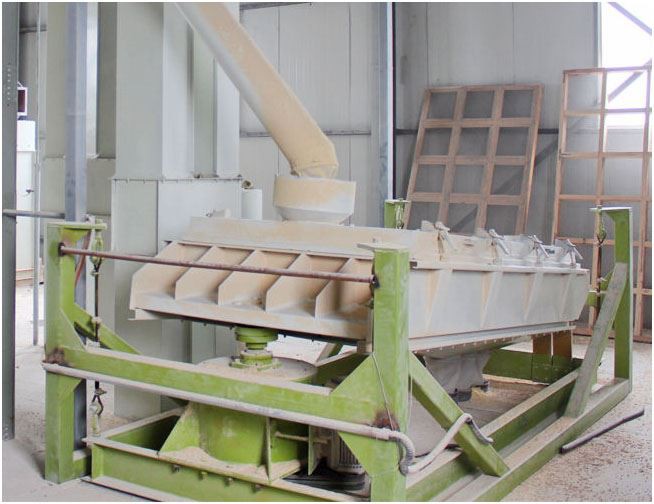 * The Pellet sieving and packing part is to sieve, classify, and pack the pellets into bags.
The sieving machine in the pellet production line is a two- or three-layer machine, designed to remove dust from pellets and classify pellets by size.
Different clients have different pellet size requirements; we design rotary pellet sieves to sieve and classify pellets.
We provide packing solutions to bag and seal pellets.
Based on the client's bag requirements, including bag weight and features, we provide the appropriate packing machine to pack pellets for delivery and storage.
We also design storage soils to bulk store the pellets.

Hot Tags: livestock feed production equipment, China, manufacturers, factory, buy, cheap, price, for sale, Fish Feed Pellet Extruder, Diesel Engine Fish Feed Pellet Making Machine, Shrimp Feed Extruder Machine, Small Animal Feed Pellet Plant, vertical mixer machine, poultry feed grinder and mixer


