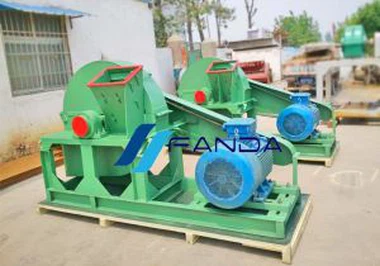

How to Choose the Right Feed Grinder
Jul 06, 2020
1.The working principle of the Feed Grinder/crusher
The working principle of the crusher is similar to that of the pulverizer. It uses a pair of rollers with different rotation speeds to rotate relative to each other. When the compressed particles are cooled by a cooler, they enter the entrance of the crusher, and then enter the two rollers through the opened valve. In the process, the zigzag teeth on the two rollers move at different speeds to shear and squeeze the particles. The required crushing size can be obtained by adjusting the distance between the rollers. If it is not necessary to break, push the operating lever to close the valve, the pellets pass through the bypass, and at the same time touch the travel switch to stop the motor when it is powered off.
2. The main structure of the Feed Grinder/crusher
There are currently three types of crushers: pair-roll, three-roll and four-rollers. Generally, the crusher is equipped with a pair of rollers. The crusher is mainly composed of a fixed fast roller, a movable slow roller, a rolling distance adjustment mechanism, a valve operating mechanism, a transmission mechanism and a frame. The four-roll crusher is additionally equipped with a homogenizer to make the flow into the two pairs of rolls even.
Roll
The roller is the main working part of the crusher. It is divided into a fast roller and a slow roller. The two rollers have the same diameter, length, and tooth profile, but the speed is different. The speed ratio of the fast and slow rollers is generally 1.5:1, and they rotate in opposite directions. The tooth pitch is generally 2.5-3mm, suitable for crushing into 1.5-2.5mm granules. The teeth of the two rolls are processed into a certain slope, which can make the rolls run more smoothly, which is beneficial to the shearing effect of the rolls on the particles and improves the crushing efficiency.
The roll body of the roll is made of bimetallic centrifugal casting, the outer layer is a 25mm thick hardness layer, the hardness is Rockwell hardness 66-78; the roll shaft head is washed with 45# steel for rough processing, and then pressed in after quenching and tempering. Roller body. After the roller hobbing is worn out, it can be repaired by wire drawing and can be used repeatedly.
Rolling distance adjustment mechanism
Both ends of the roll shaft are equipped with a rolling distance adjustment mechanism, which adjusts the distance between the rolls according to the crushing granularity requirements. If a hard object enters the crushing zone, the rolling distance can be automatically increased. After it passes through the roll, the original rolling distance can be automatically restored to protect the teeth from damage.
The fast roller bearing seat of the crusher is fixedly installed on both sides, while the slow roller shaft is installed on the outer swingable bearing seat. When adjusting the tie pitch, first loosen the locking handle, turn the adjusting hand wheel, and drive the adjusting screw to move the slow roll chock back and forth, that is, change the pitch size. The size of the rolling distance is displayed on the indicator or measured with a plug gauge. After adjustment, use the locking handle to lock it. When adjusting, the rolling distances at both ends must be the same. In this mechanism, the compression spring keeps the slow roller with proper compression force, and its pressure is adjusted by two adjusting nuts. The limit screw in the mechanism limits the distance between the slow roll and the fast roll. Generally, the limit screw is adjusted to the minimum rolling distance.
Transmission mechanism
The crusher adopts a triangular belt drive, the motor drives the fast roller through the belt deceleration, and the fast roller drives the slow roller through the reverse belt transmission. The tension of the first-stage belt drive is adjusted by adjusting the position of the motor on the slide rail. The tension of the second-stage belt drive is adjusted by the spring to tighten the idler.
Valve operating mechanism
It is used to control the flow direction of pellets and is controlled by a joystick. When the joystick is moved to the A position, the bypass is closed, the crushing zone is connected, the travel switch is reset, the machine starts to work, and the pellets directly enter the two rolls for crushing. When the pellets do not need to be crushed, turn the joystick to the B position, the crushing zone is closed, the bypass is opened, the travel switch is activated, the machine stops, and the pellets flow out of the bypass.